 Octomate
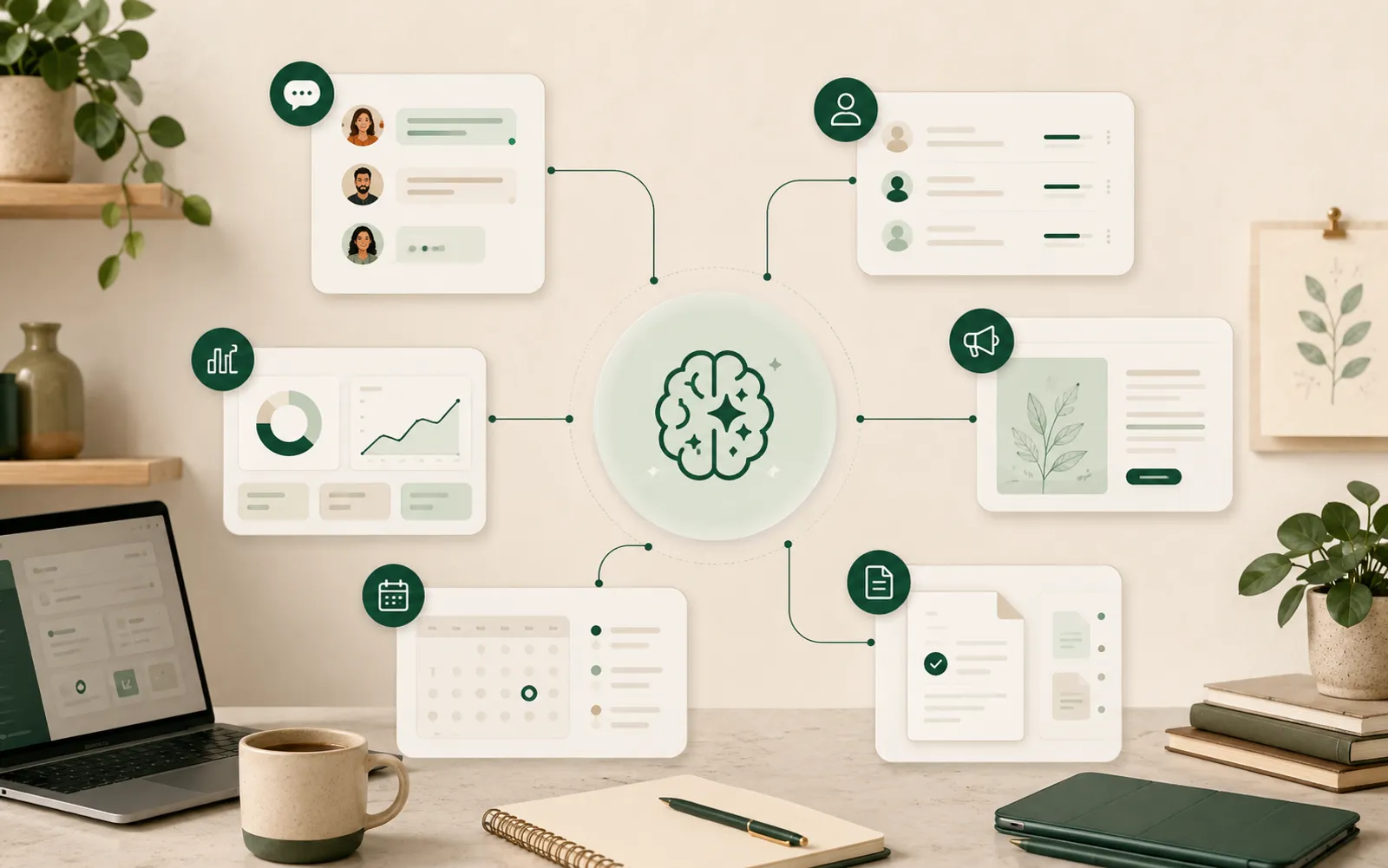
Artificial intelligence is no longer a technology reserved for large companies.
In 2026, many SMEs are already starting to use AI for very specific tasks: answering customers, creating content, preparing quotes, classifying emails, analysing documents, organizing data or automating internal processes.
And although there is still a long way to go, the shift is already visible.
According to data published from INE statistics, in 2025 21.1% of Spanish companies with more than 10 employees were already using artificial intelligence. Among companies with fewer than 10 employees, usage also grew to 13.4%.
But the most interesting point is not only how many companies use AI. What matters is what they use it for.
Because the difference between an SME that “tries AI tools” and an SME that really improves its operations is one thing: applying AI to real business processes.
1. They are automating customer service
One of the clearest uses of AI in SMEs is customer service.
Many companies receive the same questions every day:
- “Do you have availability?”
- “What is the price?”
- “Where are you located?”
- “Can I book?”
- “What documentation do I need?”
- “When can you help me?”
Responding quickly is key, but doing it manually consumes a lot of time.
That is why many SMEs are starting to use AI agents or automations to:
- answer frequently asked questions;
- collect customer data;
- route important queries to the team;
- send information automatically;
- confirm appointments;
- reduce response times;
- serve customers outside working hours.
The key is not creating a generic chatbot that answers anything. The key is creating a system connected to the business: opening hours, services, prices, availability, CRM, forms or calendar.
That is where AI starts to become truly useful.
At Octomate, we help SMEs create AI agents connected to their real processes, so they can serve customers better without overloading the team.
2. They are using AI to sell better
Another increasingly common use is sales.
Many SMEs do not have a problem with a lack of potential customers. They have a follow-up problem.
They receive leads from the website, WhatsApp, Instagram, forms or calls, but some of those opportunities are lost because nobody replies in time or because there is no clear commercial process.
AI and automation can help at several points:
- automatically registering new leads;
- classifying opportunities by customer type;
- sending an immediate first response;
- creating sales tasks;
- reminding the team to follow up;
- generating personalised emails;
- detecting warm opportunities;
- preparing proposals or quotes.
This gives the sales team more context and reduces time spent on administrative work.
AI does not sell on its own.
But it can help ensure that no lead goes unanswered and every opportunity gets follow-up.
3. They are creating content faster
Many SMEs need to publish content, reply to reviews, send newsletters, update the website or create posts for social media.
The problem is that they usually do not have a dedicated marketing team.
That is why generative AI has become a very useful tool for small businesses.
It is being used to:
- write social media posts;
- prepare newsletters;
- create website copy;
- reply to Google reviews;
- generate content ideas;
- adapt commercial messages;
- create product descriptions;
- improve existing texts.
Using AI to generate content does not mean publishing any automatic text without review. AI works best when there is a strategy behind it: brand tone, target audience, clear offer and human supervision.
An SME can save a lot of time with AI, but the final judgment should remain human.
4. They are automating administrative tasks
This is probably one of the use cases with the most real impact.
Many SMEs lose hours every week on tasks that do not add direct value:
- copying data between tools;
- updating spreadsheets;
- sending repetitive emails;
- renaming files;
- requesting documentation;
- classifying invoices;
- creating folders;
- recording requests;
- preparing reports;
- reviewing forms;
- consolidating information.
AI and automation can turn many of these processes into automatic workflows.
For example:
- a customer fills in a form;
- the system saves the data;
- creates a folder;
- sends an email;
- updates a spreadsheet;
- notifies the team;
- and creates a task.
All without anyone manually copying and pasting information.
This type of automation is not always visible from the outside, but internally it can transform how work gets done: fewer errors, fewer repeated tasks, less chaos and more control.
5. They are using AI to analyse documents and data
Another clear trend is using AI to work with information.
Many companies have data spread across PDFs, spreadsheets, emails, forms, invoices, contracts or internal tools.
AI can help to:
- extract information from documents;
- summarise long texts;
- classify requests;
- detect important data;
- organise information;
- generate reports;
- find patterns;
- answer questions about internal documents.
An accounting firm can classify received documentation. A real estate agency can summarise client or property information. A clinic can organise incoming requests. A service company can analyse repeated incidents.
The value is not just “reading documents faster”. The value is turning messy information into useful actions.
6. They are connecting tools that used to work separately
Many SMEs work with too many disconnected tools: Gmail, WhatsApp, Excel, Google Drive, CRM, calendar, forms, ERP, payment platforms or social media.
The problem is not using many tools. The problem is that they do not talk to each other.
This is where automation plays a key role.
An SME can connect its systems so that:
- leads enter the CRM automatically;
- appointments are created in the calendar;
- documents are saved in Drive;
- quotes are sent by email;
- tasks are assigned to the team;
- payments are recorded;
- customers receive reminders;
- data updates without manual intervention.
AI works much better when it is connected to the real flow of the company. Not as an isolated tool, but as an intelligent layer on top of processes.
At Octomate, we do not implement AI “because it is trendy”. We design automations connected to the tools each company already uses, so technology fits its real operations.
What is still hype in AI for SMEs
Although AI is creating a lot of value, there is also a lot of noise.
Not everything labelled “AI” improves a business.
Examples of poorly applied AI include:
- chatbots that do not understand the customer;
- tools that integrate with nothing;
- automations nobody maintains;
- automatic replies without supervision;
- badly designed processes that are simply automated;
- content generated without strategy;
- solutions that are too complex for small companies.
The problem is usually not the technology. The problem is implementing AI without first understanding the business.
Automating a bad process does not make it good. It only makes it faster.
That is why, before applying AI, an SME should ask: what specific problem do we want to solve?
If the answer is not clear, it is probably not time to implement AI yet.
What sets apart an SME that uses AI well
The SMEs making the best use of AI in 2026 have something in common: they do not start with the tool, they start with the process.
They do not say “we want to use AI”. They say things like:
- “We are wasting too much time answering the same things.”
- “Leads are slipping away.”
- “It takes us too long to prepare quotes.”
- “We have too much disorganised information.”
- “The team is overloaded with administrative tasks.”
And from there, they look for a solution.
That is the difference. Useful AI is not the most spectacular AI. It is the AI that solves a real day-to-day friction.
The big challenge: lack of knowledge and fear of getting it wrong
Although adoption is growing, many companies have still not taken the step.
The most common reasons include lack of knowledge, privacy concerns, possible legal consequences and implementation cost. According to analysis based on business data, 79% of companies still did not use AI, and lack of knowledge was one of the main barriers.
This is normal. Many SMEs do not need to become experts in artificial intelligence.
What they need is guidance to understand:
- which processes to automate first;
- which tools to use;
- how to protect data;
- how to keep human control;
- how to measure whether it really works;
- how to start without turning it into a huge project.
The good news is that today it is possible to start gradually. You do not need to transform the whole company. It is enough to choose one specific process, automate it well and measure the impact.
Conclusion: SMEs do not need more AI, they need better AI
In 2026, many SMEs are already using artificial intelligence.
But the real opportunity is not using more tools. It is using technology better.
AI can help an SME respond faster, sell better, reduce repetitive tasks, organise information and improve daily operations.
But it only really works when applied with purpose.
- It is not about replacing people.
- It is not about complicating the business.
- It is not about following a trend.
It is about automating the repetitive so the team can focus on what matters.
And that is the real opportunity for SMEs: working better, with more speed, more order and less manual load.
Automate the repetitive. Amplify what matters.
