 Octomate
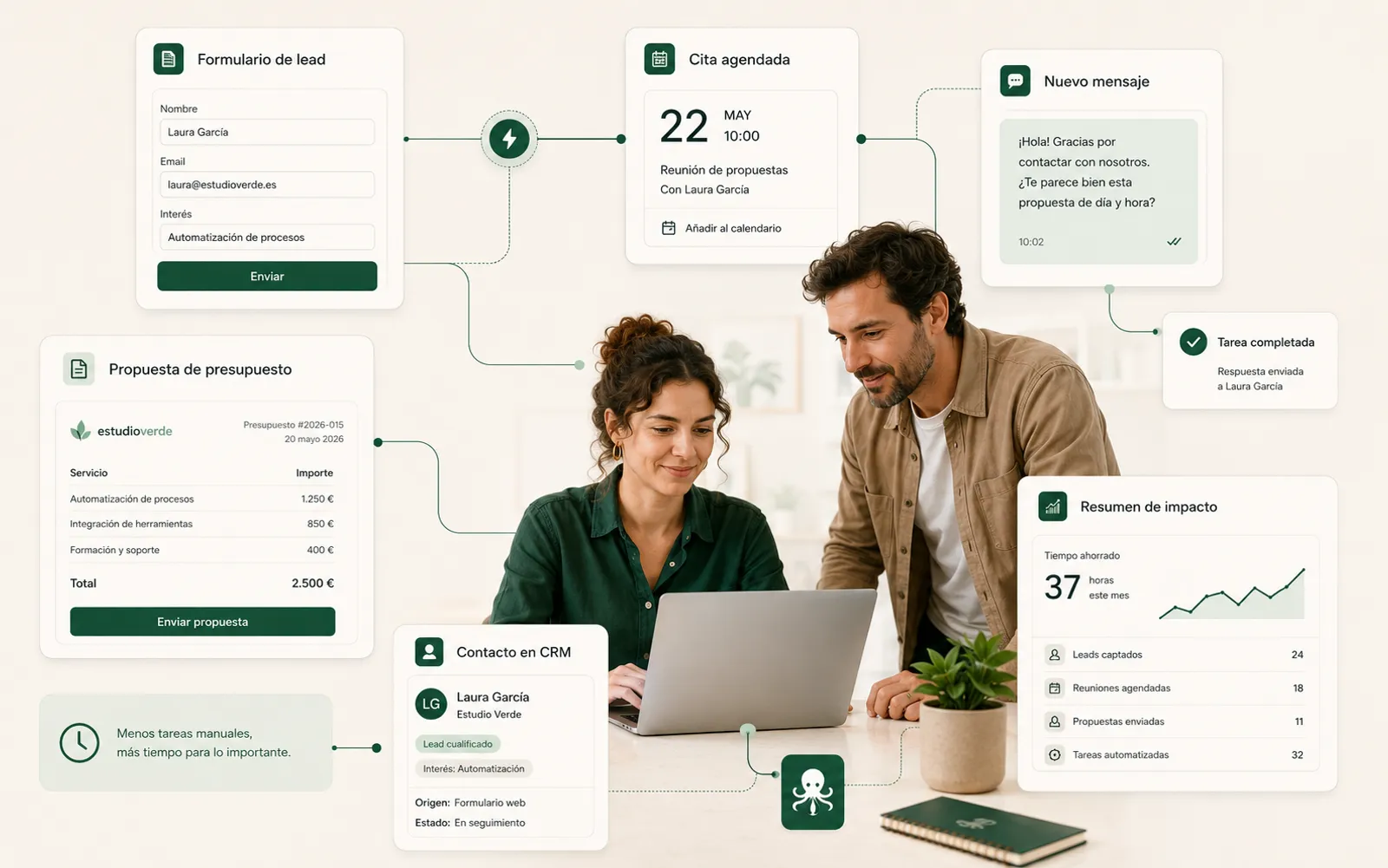
For years, artificial intelligence seemed reserved for large companies, banks, tech firms or corporations with huge innovation teams.
But in 2026, the reality is very different.
Today, a small business can automate customer replies, generate quotes, classify emails, organize appointments, analyze documents or connect internal tools without building its own technology department.
AI is no longer a futuristic promise. For many SMEs, it is becoming a practical tool to save time, reduce errors and work better.
Most importantly, it is no longer about "having AI" because it is trendy, but about using it where it actually creates value.
AI adoption in Spanish companies has already accelerated
The data shows a clear shift. In 2025, 21.1% of Spanish companies with more than 10 employees were already using artificial intelligence, compared with much lower figures in previous years. Among companies with fewer than 10 employees, AI use also grew to 13.4%.
This means AI is no longer entering only from the top, through large corporations. It is also starting to reach small businesses, lean teams and companies that simply want to operate more efficiently.
This shift is not happening because every SME wants to become a technology company. It is happening because many have noticed something simple: repetitive tasks consume too many hours every week.
And that is where AI and automation make the most sense.
What SMEs are automating in 2026
Most SMEs do not start with huge artificial intelligence projects. They start with specific problems.
For example:
- answering repetitive customer messages;
- organizing requests that arrive through forms;
- generating quotes or commercial documents;
- automatically following up with leads;
- sending appointment reminders;
- classifying emails;
- summarizing documents;
- updating spreadsheets;
- connecting the CRM with WhatsApp, Gmail or Google Sheets;
- publishing content and replying to reviews.
They are small tasks, but together they have a huge impact.
An SME does not need to automate the whole company at once. Often, it is enough to identify three or four processes that repeat every week and build a system that makes them faster, with fewer errors and less manual dependency. At Octomate, we help SMEs identify exactly those processes: repetitive tasks, friction points and real opportunities where automation can save time from the first month.
AI does not replace the business: it strengthens operations
One of the most common mistakes is thinking AI is here to replace everything.
In reality, in a well-designed SME workflow, AI does not replace the team's judgment. It removes repetitive workload so people can spend more time selling, serving customers better, making decisions or improving the service.
For example, an AI agent can prepare a first response to a customer, but a person can review it before sending. It can classify a request, but the team decides its priority. It can generate a quote draft, but the sales lead validates the final amount.
The key is combining automation with human control.
This is especially important because poorly applied AI can create noise, errors or mistrust.
But when it is well integrated, it can become an operational assistant that works 24/7 on specific processes.
It is not just about using ChatGPT
Many companies have already tried tools such as ChatGPT, Gemini or Copilot. That is a good first contact, but it is not enough to transform the operations of an SME.
The real difference appears when AI connects with the tools of the business.
- a web form that automatically creates a lead in the CRM;
- a WhatsApp flow that answers frequently asked questions and books an appointment;
- a spreadsheet that updates itself;
- a system that generates quotes from customer data;
- an automation that alerts the team when an opportunity is warm;
- an agent that checks internal information before replying.
That is where AI stops being an isolated tool and starts becoming part of the company's operating system.
At Octomate, we do not focus on "adding AI for the sake of it". We design automations connected to the tools each company already uses, so the technology fits the way it actually works.
Why it is now more accessible for an SME
Until recently, automating processes or using artificial intelligence required high budgets, internal technical teams and long projects.
Today, the landscape has changed. Tools are more accessible, integrations are faster and many solutions can be built in days or weeks.
Digitalization programs such as Kit Digital have also helped many SMEs start modernizing processes and adopting new tools. Since its launch, Kit Digital has granted more than 936,000 subsidies worth over 3.6 billion euros, according to recently published data.
- automating lead capture;
- improving customer service;
- organizing internal data;
- reducing administrative tasks;
- creating a commercial follow-up system.
This does not mean every automation is good. It means the entry barrier has dropped significantly. Now, an SME can start with something very specific and scale gradually from there.
The big challenge: knowing where to start
The problem is no longer a lack of tools. In fact, the opposite often happens: there are too many.
The real challenge for an SME is knowing what is worth automating first.
A good initial question would be: what task repeats often, consumes time and does not require a complex decision every time?
- copying data from a form into a spreadsheet;
- answering the same questions again and again;
- sending appointment reminders;
- requesting missing documentation;
- following up on quotes;
- classifying incoming requests;
- generating basic reports;
- recording information in several tools.
If a task meets those conditions, it is probably a good candidate for automation. The key is to start with simple, measurable and useful automations. Not huge projects that are hard to maintain.
Useful AI is the AI you notice every day
The most valuable artificial intelligence for an SME is not always the most spectacular.
It does not need to be a complex prediction system, a huge chatbot or a tool full of features nobody uses.
Sometimes, the best AI is the one that makes:
- the team stop copying and pasting data;
- customers receive faster replies;
- commercial opportunities stop falling through the cracks;
- administrative tasks take half the time;
- documents generate automatically;
- information stay better organized;
- processes depend less on one person's memory.
That is the real impact: less repetitive work and more time for what matters. Several productivity analyses also suggest that AI is starting to improve business efficiency, especially when applied to specific and repetitive tasks.
Automation does not mean losing closeness
A common concern among many SMEs is thinking that automation can make the business feel colder or less human.
When done well, the opposite happens.
Good automation can help respond sooner, follow up better, avoid forgotten tasks and offer a more professional customer experience.
For example, a gym can automate appointment reminders. A clinic can organize incoming requests. A real estate agency can automatically respond to leads. An accounting firm can request pending documentation without manually writing every email. Closeness does not disappear. What disappears is part of the repetitive work that made it harder to serve customers well.
How to start with AI and automation in an SME
To start well, you do not need a complete transformation. It is better to follow a simple process:
- Detect repetitive tasks Review which processes are done manually every week and how much time they consume.
- Prioritize by impact Do not automate what looks most impressive, but what saves the most time or avoids the most errors.
- Start with an MVP Create a functional first version, test it with the team and improve it.
- Connect tools Automation should integrate with what the company already uses: email, CRM, WhatsApp, Excel, forms, ERP or calendar.
- Measure results Hours saved, response time, recovered leads, reduced errors or eliminated tasks.
At Octomate, we help you do this simply: we analyze how your company works, identify real automation opportunities and build solutions adapted to your current tools.
Conclusion: AI is already within reach of SMEs
In 2026, the question is no longer whether artificial intelligence will reach SMEs. It already has.
The real question is how to apply it well.
The companies that make the best use of this technology will not necessarily be the ones using the most tools, but the ones that know how to integrate them better into their daily processes.
Because AI is not about complicating the business. It is about simplifying it.
It is about automating the repetitive to amplify what matters.
And that is where SMEs have a huge opportunity: work better, respond faster, reduce manual load and compete with more capacity, without needing to become large corporations.
Automate the repetitive. Amplify what matters.
